

What Professional Cleaners Do That's Hard to Replicate Yourself
About this post
A look at what separates a professional clean from a DIY tidy-up: the hidden bacteria risks of everyday tools like kitchen sponges, the cleaning sequence people get wrong, and the product knowledge and equipment that make pros genuinely more effective—not just faster.
Posted by
Meg from UrbanTags
- Wellbeing
- City life
Book a treatment at home
Share
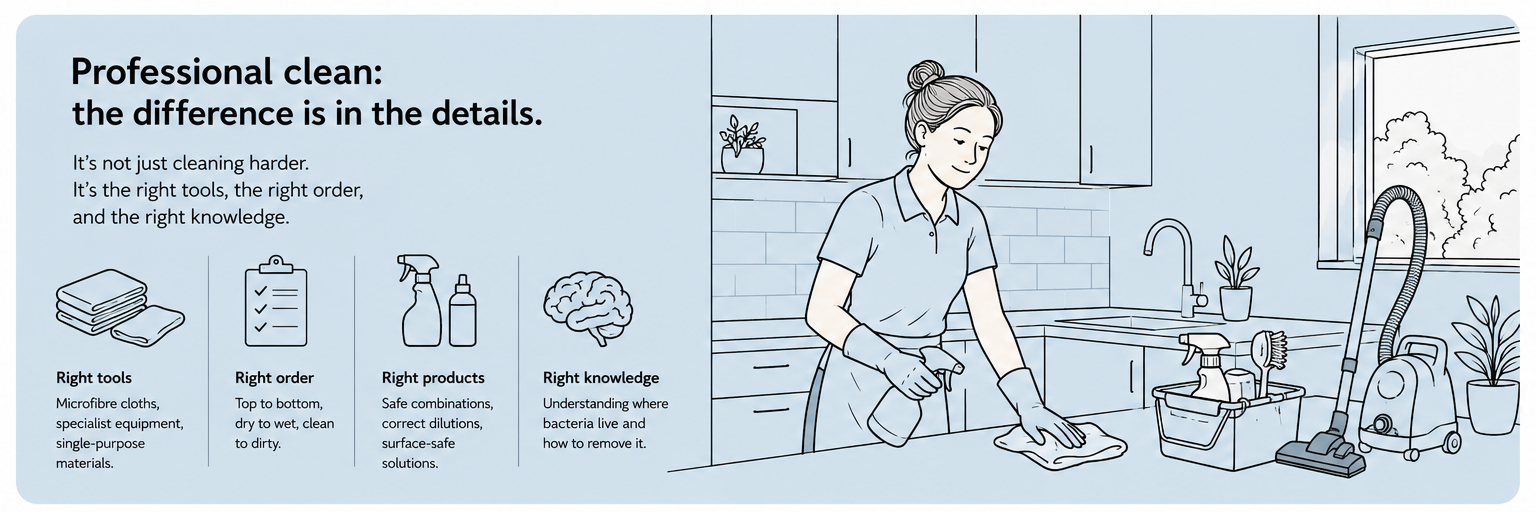
Most people assume a professional clean is just their own Saturday-morning routine, done faster. It isn't. The gap between a DIY tidy-up and a professional clean is mostly invisible — it lives in the tools, the sequencing, and a working knowledge of where household bacteria actually live.
The sponge problem nobody thinks about
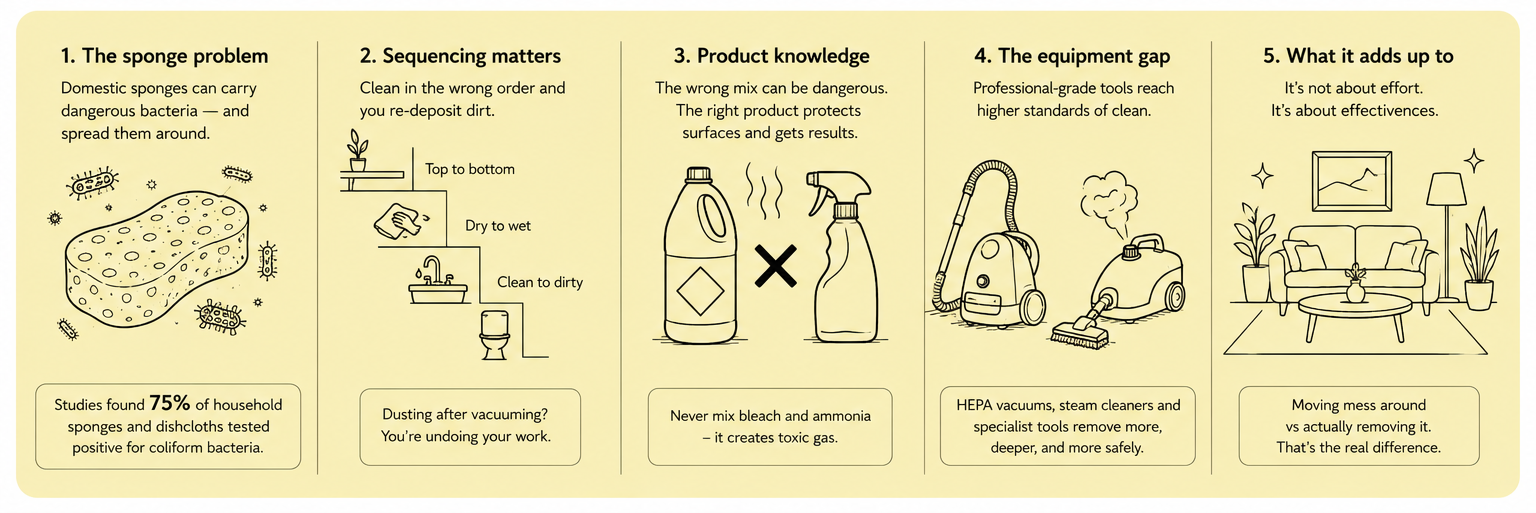
Start with the item most of us reach for dozens of times a week without a second thought: the kitchen sponge. Multiple independent studies have found that domestic sponges are among the most contaminated items in the average home. One widely cited U.S. survey of 22 households found that 75% of household sponges and dishcloths tested positive for coliform bacteria — the family of bacteria that includes E. coli and typically signals fecal contamination. Other studies of domestic kitchens have found sponges testing positive for E. coli, fecal coliforms, and even Salmonella species.
The mechanism is what makes this a genuine expertise gap rather than a laziness problem: the more force used to scrub with a contaminated sponge, the more bacteria transfer onto the surface being "cleaned." Research also shows that when a contaminated sponge or cloth carries Staphylococcus aureus, that same contamination reliably turns up on kitchen counters, sinks, refrigerator shelves and handles in the same kitchen — meaning one dirty tool can quietly recontaminate an entire kitchen in the course of "cleaning" it.
Professional cleaners are trained around this. That typically means using colour-coded, single-purpose cloths for different zones (a cloth for the toilet is never the cloth that touches a countertop), replacing or properly disinfecting cleaning tools between jobs, and understanding that microfibre cloths and brushes generally carry lower bacterial loads than sponges — something most households never think to change.
Sequencing: the part that's easy to get backwards
A professional clean follows a specific order — top to bottom, dry to wet, least-contaminated to most-contaminated surfaces — because doing it in the wrong order means re-depositing dirt onto surfaces you already cleaned. Dusting a shelf after vacuuming the floor beneath it, for instance, undoes the vacuuming. This sounds obvious in theory but is one of the most common things people get wrong when cleaning their own homes under time pressure.
Product knowledge most people never build
There's also a chemistry layer to professional cleaning that's easy to underestimate. Knowing which products can and can't be combined (mixing bleach and ammonia-based cleaners, for example, produces toxic chloramine gas), which surfaces are damaged by acidic versus alkaline products, and which dilution ratios actually work is knowledge built through repetition across hundreds of different homes — not something most people accumulate cleaning their own one or two properties.
The equipment gap
Professional-grade equipment — HEPA-filtered vacuums, steam cleaners capable of reaching temperatures that kill bacteria without chemicals, and descaling tools designed for specific surfaces — routinely outperforms consumer-grade tools on jobs like grout, oven interiors, and limescale. It's a genuine capability difference, not just a matter of elbow grease.
What this adds up to
None of this is about shaming anyone's Sunday cleaning routine — most households simply don't have the reason to learn any of it. But it explains something people often can't quite articulate: why a professionally cleaned home feels different, not just tidier. It's the difference between moving mess around and actually removing it — a distinction that lives almost entirely in details you wouldn't think to look for unless you already knew where to look.
Sources
Home & Garden Information Center, Clemson University — NSF household bacteria study (2011), 22 households.
Borrusso, P. & Quinlan, J. (2017). Bacterial contamination of kitchen sponges and cross-contamination to surfaces.
Frontiers in Microbiology (2026). Microbiological contamination of domestic kitchen sponges.
PMC — Viability of bacterial microbiomes in home kitchen dish sponges.
CNN Health (2022). Reporting on EU-backed kitchen sponge and brush hygiene research.
Discover the easy way to book cleaning services, as well as at-home clinic and spa treatments with the Urban app.
Book on-demand servicesBook a standard or deep clean, from 7am to 11pm, 7 days a week.
Book a home clean