

The Real Amount of Time Cleaning Takes — And What Buying It Back Is Worth
About this post
A breakdown of how many hours cleaning really costs you—UK time-use data shows 200+ hours a year—paired with Harvard research on "buying time back" showing that outsourcing chores like cleaning is one of the most reliable ways to boost happiness, regardless of income.
Posted by
Meg from UrbanTags
- Wellbeing
- City life
Book a treatment at home
Share
Before we get to the psychology of "buying time," it's worth putting a real number on the thing you'd be buying back.
What cleaning actually costs you, in hours
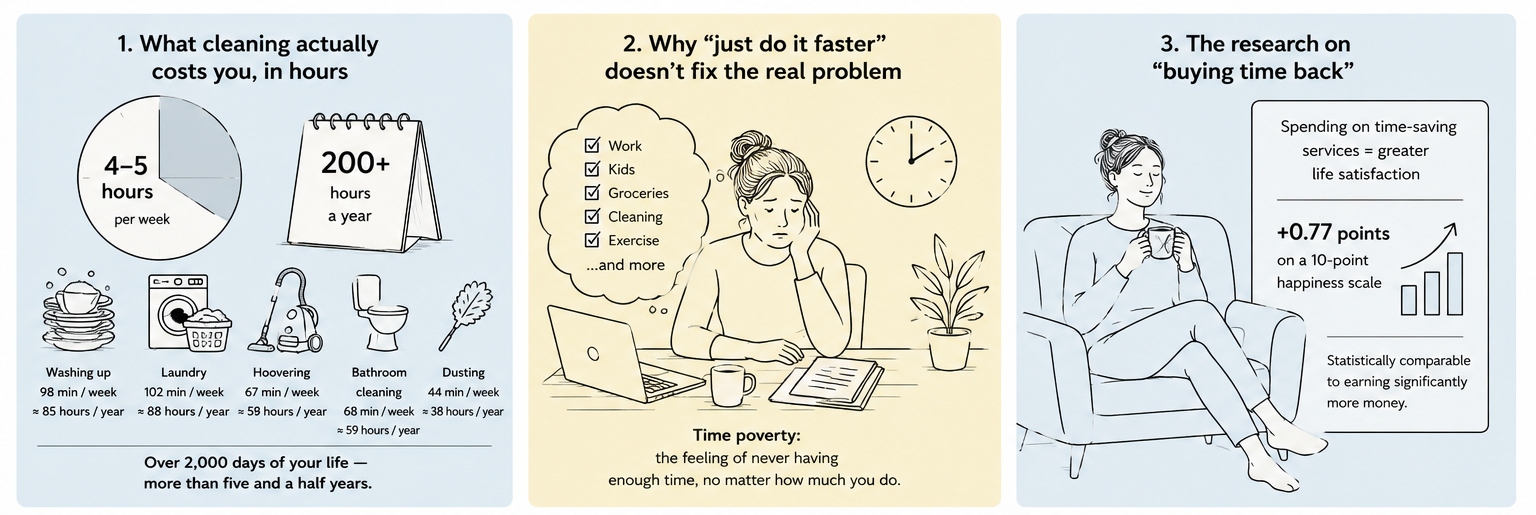
UK survey data suggests the average adult spends somewhere between 4 and 5 hours a week on household cleaning, with two in three people spending closer to 5 hours weekly once broader chores are included. Zoom out to a full year and one widely cited UK survey put the figure at 208 hours annually on household chores as a whole — and in the most house-proud regions, closer to 228 hours a year.
Broken down by task, the biggest time sinks are rarely the ones people expect. Washing up alone accounts for around 98 minutes a week — roughly 85 hours a year, or an estimated 170 days across a lifetime. Laundry takes a similar toll: about 102 minutes a week, 88 hours a year, and an estimated 173 days over a lifetime. Add hoovering (67 minutes/week), bathroom cleaning (68 minutes/week) and dusting (44 minutes/week), and the average adult is looking at well over 2,000 days of their life — more than five and a half years — spent on chores.
Why "just do it faster" doesn't fix the real problem
The issue isn't only the raw hours. It's what economists and psychologists call "time poverty" — the chronic feeling of having too much to do and not enough time to do it, independent of how busy you objectively are. Research from Harvard Business School has found that people who feel more time-pressed report lower life satisfaction across the board: more anxiety, poorer eating and exercise habits, and more disrupted sleep. Rising incomes over recent decades have made this worse, not better — as more of us take on demanding jobs, subjective time scarcity has climbed even as some objective measures of leisure time haven't changed much.
The research on "buying time back"
This is where a large body of research on outsourcing becomes genuinely useful. A landmark study published in PNAS by Harvard's Ashley Whillans and colleagues surveyed more than 6,000 adults across the US, Canada, Denmark and the Netherlands and found that spending money on time-saving services — housecleaning among the most common — was consistently linked to greater life satisfaction, regardless of income level. In a follow-up experiment designed to test causation rather than just correlation, working adults reported measurably greater happiness after a time-saving purchase than after a comparable material purchase.
The effect isn't trivial in size. In the US portion of the study, buying time increased self-reported happiness by roughly 0.77 points on a 10-point scale — a shift researchers describe as statistically comparable to earning significantly more money, without the income actually changing.
Why people resist doing this, even when they can afford it
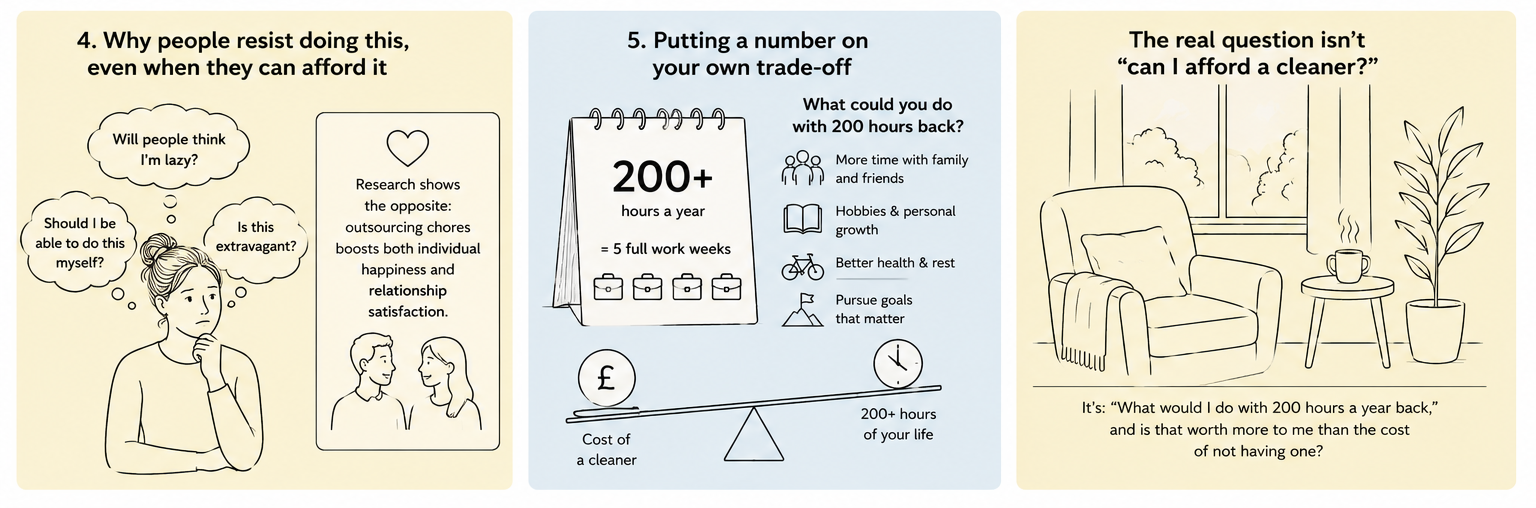
Interestingly, Whillans' research found that people — even those who could easily afford it — often feel guilty about outsourcing chores, worrying it signals laziness or a lack of capability to others. But her data suggests the opposite reading is more accurate: households that regularly outsourced chores like cleaning and cooking reported not just individual happiness gains but improved relationship satisfaction, and the benefit held regardless of which partner in a couple "used" the freed-up time.
Putting a number on your own trade-off
If cleaning costs you roughly 4–5 hours a week, that's 200+ hours a year — the equivalent of five full 40-hour work weeks — spent on a task that, per the research above, is one of the most reliably "outsourceable" sources of stress in a household. The question worth asking isn't really "can I afford a cleaner" — it's closer to "what would I do with 200 hours a year back," and whether that answer is worth more to you than the cost of not having them.
Sources
Statista / Kärcher (2019). UK survey on time spent cleaning per week.
Tap Warehouse (2023). Home Sweet Home: A Report Into the Nation's Cleaning Habits.
Ideal Home / Airtasker survey (2022). Annual UK household chore time breakdown.
Whillans, A.V. et al. (2017). Buying time promotes happiness. PNAS, 114(32).
Harvard Business School Working Knowledge (2017, 2019). Coverage and follow-up interviews with Ashley Whillans on time poverty and outsourcing chores.
Discover the easy way to book cleaning services, as well as at-home clinic and spa treatments with the Urban app.
Book on-demand servicesBook a standard or deep clean, from 7am to 11pm, 7 days a week.
Book a home clean