

The Deep-Clean Jobs Everyone Puts Off — And How to Actually Do Them Well
About this post
A practical, research-backed guide to the three cleaning jobs people postpone the longest—windows, ovens, and fridges. Covers proper technique for streak-free glass and baked-on grease, plus why regular fridge cleaning is a genuine food-safety issue, not just a tidiness one.
Posted by
Meg from UrbanTags
- Wellbeing
- City life
Book a treatment at home
Share
Windows, ovens and fridges have something in common: they're the three household jobs people postpone the longest, because none of them are part of a "quick tidy." Here's how to do each one properly — and why it's worth the effort.
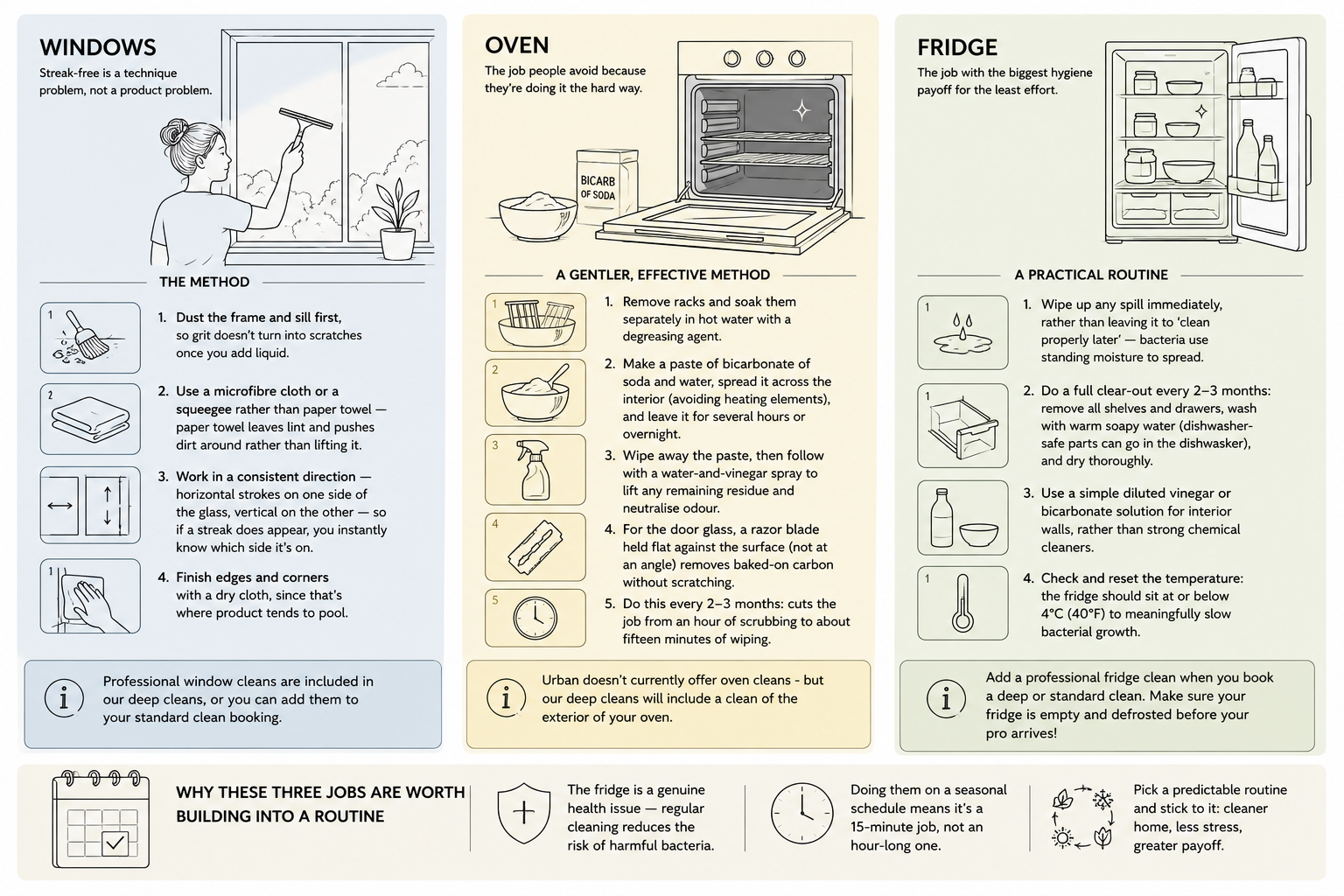
Windows: streak-free is a technique problem, not a product problem
Streaks are almost always caused by one of two things: cleaning in direct sunlight, or using too much product. Sunlight causes cleaning solution to dry before you've had a chance to buff it off, leaving behind streaky residue — so glass is easiest to clean on an overcast day or in the shade.
The method:
Dust the frame and sill first, so grit doesn't turn into scratches once you add liquid.
Use a microfibre cloth or a squeegee rather than paper towel — paper towel leaves lint and pushes dirt around rather than lifting it.
Work in a consistent direction — horizontal strokes on one side of the glass, vertical on the other — so if a streak does appear, you instantly know which side of the window it's on.
Finish edges and corners with a dry cloth, since that's where product tends to pool.
Interested in a professional window clean? They're included in our deep cleans, or you can add them to your standard clean booking.
The oven: the job people avoid because they're doing it the hard way
Baked-on grease and carbon buildup are stubborn because oven temperatures effectively cook food residue onto the enamel. Commercial oven cleaners work by using strong alkalis to chemically break down that carbon — but they also produce fumes that specifically warrant ventilation, and repeated exposure to strong alkaline cleaning agents has been associated with respiratory irritation in cleaning-product research, which is worth bearing in mind if you're doing this in a small kitchen with the extractor off.
A gentler, effective method:
Remove racks and soak them separately in hot water with a degreasing agent while you work on the oven itself.
Make a paste of bicarbonate of soda and water, spread it across the interior (avoiding heating elements), and leave it for several hours or overnight — it works by gradually chemically breaking down grease.
Wipe away the paste, then follow with a water-and-vinegar spray to lift any remaining residue and neutralise odour.
For the door glass, a razor blade held flat against the surface (not at an angle) removes baked-on carbon without scratching — a professional technique that works far better than scrubbing.
Doing this every 2–3 months, rather than waiting until buildup is severe, cuts the job from an hour of scrubbing to about fifteen minutes of wiping.
Urban doesn't currently offer oven cleans - but our deep cleans will include a clean of the exterior of your oven.
The fridge: the job with the biggest hygiene payoff for the least effort
This is the one worth taking seriously — not because a dirty fridge looks bad, but because it's a genuine food-safety issue. Studies of household refrigerators have found significant bacterial contamination on interior surfaces, with shelves the most commonly affected area, and pathogens including Salmonella, Listeria and Staphylococcus regularly isolated from swabs. One survey found that only 16% of people clean their fridge as often as once a month. That matters specifically because of Listeria: unlike most foodborne bacteria, it can survive and slowly multiply even at standard refrigerator temperatures, and health agencies including the FDA and Harvard Health specifically recommend regular fridge cleaning and prompt spill removal as a defence against it — because simply throwing out an expired item doesn't remove bacteria that may have already spread to shelves or drawers.
A practical routine:
Wipe up any spill immediately, rather than leaving it to "clean properly later" — Listeria and other bacteria use standing moisture to spread to other surfaces.
Do a full clear-out every 2–3 months: remove all shelves and drawers, wash with warm soapy water (a dishwasher-safe glass shelf can usually go straight in the dishwasher), and dry thoroughly before replacing, since bacteria need moisture to survive.
Use a simple diluted vinegar or bicarbonate solution for interior walls, rather than strong chemical cleaners, since residue can transfer onto food.
Check and reset the temperature while you're in there — the fridge itself should sit at or below 4°C (40°F), which meaningfully slows bacterial growth compared with warmer settings that many domestic fridges drift to over time.
Interested in a professional fridge clean? You can add that task when you book a deep cleans, or standard clean. Make sure your fridge is empty and defrosted before your pro arrives!
Why these three jobs are worth building into a routine
None of these are jobs anyone enjoys, which is exactly why they get pushed to "one day." But of the three, the fridge is the one with a genuine health stake rather than just an aesthetic one — and doing all three on a predictable seasonal schedule, rather than waiting for visible grime, is consistently the difference between a fifteen-minute job and an hour-long one.
Sources
OSU Extension Service — refrigerator and freezer cleaning frequency guidance.
Harvard Health Publishing — Listeria prevention guidance.
FDA — What You Need to Know About Preventing Listeria Infections.
ScienceDirect — bacterial contamination and antibiotic resistance in domestic refrigerators.
Ilg, Y. et al. (2011). Consumer refrigerator cleaning frequency survey.
Discover the easy way to book cleaning services, as well as at-home clinic and spa treatments with the Urban app.
Book on-demand servicesBook a standard or deep clean, from 7am to 11pm, 7 days a week.
Book a home clean